
Best CCTV Installation Services in Siliguri Top Installers Features and Buying Tips

A CCTV system is only as good as its planning, installation, and after-sales support. A high-resolution camera placed at the wrong angle can miss a face. A good DVR without backup power can fail during a power cut. A cheap cable can create video loss within months, especially in rain-prone areas.
Siliguri has a growing need for CCTV security across homes, shops, warehouses, clinics, schools, hotels, and apartment buildings. The city connects North Bengal, Sikkim, Assam, Nepal, and Bhutan, so many businesses handle high footfall, deliveries, parking movement, and stock storage. That makes the choice of installer as important as the camera brand.
This guide explains how to find a reliable CCTV installer in Siliguri, what features matter, how to compare distributors, and how to choose the right system for home or business use.

How to shortlist top CCTV installers near you in Siliguri
The safest way to choose a CCTV installer is to judge the process, not just the price. A professional installer should inspect the site, ask about risk areas, explain storage needs, and give a written quote with camera model numbers.
Here is a practical shortlist of top-rated installer types to look for near you in Siliguri, with what each one is best suited for.
Installer type | Best for | What to check before hiring |
Authorised CCTV dealer and installer | Homes, shops, offices, small warehouses | Brand authorisation, GST bill, warranty terms, installation experience |
Local security system integrator | Larger buildings, hotels, schools, apartment complexes | Site survey quality, cabling plan, networking knowledge, maintenance contract |
Electrical contractor with CCTV experience | New buildings and renovation projects | Low-voltage cabling skill, conduit planning, camera angle knowledge |
IT networking and CCTV service provider | IP camera setups, remote viewing, NVR systems | Router setup skill, PoE switch knowledge, password and network security practices |
Distributor-backed installation team | Multi-camera projects and brand-specific systems | Availability of genuine products, replacement support, service response time |
A good cctv dealer siliguri, cctv installer siliguri option should be able to answer five basic questions clearly:
Which areas need fixed cameras and which need wider coverage?
How many days of recording will the system store?
Will remote viewing work on mobile data and Wi-Fi?
What happens if a camera fails within warranty?
Who will provide service after installation?
Avoid installers who only say “full HD camera” without sharing model details. Full HD usually means 1080p, but the image quality also depends on lens size, sensor quality, night vision range, compression, and camera placement.
A professional quote should include:
Camera brand and model
DVR or NVR model
Hard disk capacity
Cable type and length estimate
Power supply details
Installation charges
Warranty coverage
Mobile viewing setup
Maintenance visit terms
Ask for photos of previous installations, especially projects like yours. A home gate, medicine shop, hotel corridor, school entrance, and warehouse loading area all need different camera placement.
Key features to look for in a CCTV system
CCTV specifications can look confusing, but a few features decide most of the real-world performance.
Camera resolution and lens angle
For homes and small shops, 2 MP cameras may be enough for general monitoring. For face capture at entrances, cash counters, parking areas, or warehouse gates, 4 MP or higher often gives better detail.
Lens size also matters. A 2.8 mm lens gives a wider view, useful for rooms and small shops. A 3.6 mm or 6 mm lens gives a narrower but more detailed view, useful for gates, counters, and distant points.
The key question is simple: do you need to see activity or identify a person or vehicle? Those are different goals.
Night vision and low-light performance
Many incidents happen after dark, so night performance is critical. Infrared cameras can see in darkness, but the image is usually black and white. Colour night cameras need some ambient light or built-in warm light to show colour.
For outdoor areas, check the stated IR range, but treat it as an estimate. Real performance changes with wall colour, rain, fog, dust, reflected light, and camera height.
Weather and dust protection
For outdoor use in Siliguri, look for an IP66 or IP67-rated camera. The IP rating is an international standard used to describe protection against dust and water. IP66 generally means the camera can handle dust and strong water jets, which matters during heavy rain.
For areas where cameras may be touched, hit, or tampered with, ask about vandal-resistant dome cameras. These are useful in parking areas, staircases, schools, and public-facing corridors.
Storage and recording time
Recording duration depends on camera count, resolution, frame rate, compression, and hard disk size. H.265 compression usually stores video more efficiently than older H.264 systems, when both the camera and recorder support it.
For most homes and small shops, many buyers ask for around one to four weeks of recording. Businesses with compliance, billing disputes, or stock movement may need longer. Do not guess storage. Ask the installer to calculate it based on your chosen camera count and settings.
Remote viewing and security
Mobile viewing is useful, but it must be set up safely. Weak passwords, shared logins, and unchanged default settings can expose camera feeds.
A responsible installer should:
Change default passwords
Create separate user access if needed
Avoid sharing admin passwords casually
Update device firmware where possible
Explain how to disable access for old staff members
Set accurate date and time for evidence quality
If using an ip camera , wiffi camera, colour camrea, night vision camra setup, make sure the installer explains the difference between wired IP, wireless Wi-Fi, colour night vision, and infrared night vision. Wi-Fi cameras are convenient, but wired cameras are often more stable for shops, warehouses, and multi-storey buildings.
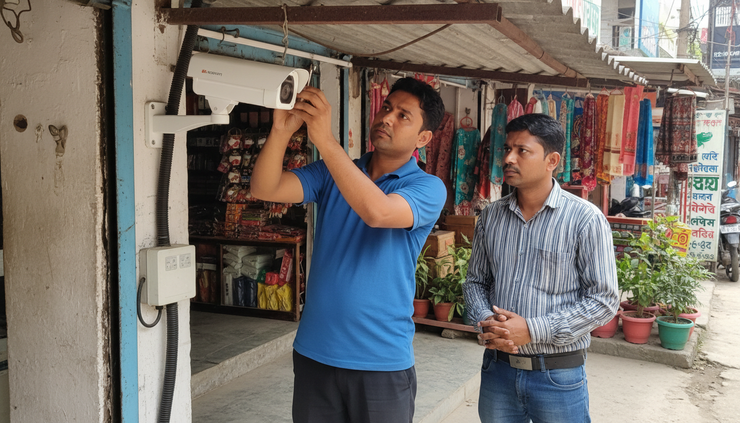
Benefits of CCTV for home and business security
CCTV does more than record crime. A well-planned system improves day-to-day visibility and helps settle disputes with facts.
For homes, CCTV helps monitor:
Main gate and boundary wall
Parking space
Staircase or lift lobby
Front door deliveries
Elderly family members entering or leaving common areas
Domestic help entry and exit timing
For businesses, it helps track:
Customer movement
Cash counter activity
Stock handling
Loading and unloading
Staff safety
After-hours entry
Parking incidents
CCTV can also support insurance and police complaints by providing time-stamped footage. Police and legal processes decide whether footage is accepted in a case, but clear video with correct date and time is always more useful than unclear clips or missing recordings.
A camera should not just cover an area. It should answer a question, such as who entered, what was taken, which vehicle arrived, or when the incident happened.
For example, a shop may install one wide-angle camera to cover the floor, but still fail to capture cash transactions clearly. A better plan would place one camera for general viewing and another focused on the billing counter. A home may cover the gate, but miss the side passage. A site survey prevents these blind spots.
CCTV also has a deterrent effect. Visible cameras, warning boards, and proper lighting can reduce casual theft, trespassing, and unauthorised access. It will not stop every incident, but it raises the risk for someone planning one.
Reliable CCTV distributors in Siliguri and what they should provide
A distributor is different from an installer. A distributor usually supplies products to dealers, installers, and sometimes bulk buyers. In Siliguri, a reliable CCTV distributor should help with product availability, warranty handling, replacement support, and genuine brand supply.
Many CCTV systems in India use well-known brands such as CP Plus, Hikvision, Dahua, Godrej, Panasonic, Bosch, and Uniview, among others. Availability changes by dealer and project type, so the better approach is to verify the supply chain rather than chase only a brand name.
When dealing with a distributor or dealer, check for:
GST invoice with product details
Brand warranty card or serial number record
Sealed product packaging
Matching serial numbers on box and device
Clear replacement policy for dead-on-arrival products
Support for firmware, app setup, and recorder configuration
Availability of cables, SMPS, connectors, junction boxes, racks, and hard disks
Be careful with very low-cost packages that do not mention hard disk brand, cable quality, or power supply details. A CCTV system is a chain. If one part is weak, the whole system suffers.
For example, copper-clad aluminium cable may cost less than pure copper cable, but poor cable quality can cause signal loss, interference, and shorter service life. Low-grade power adapters can lead to camera flickering or failure. Outdoor cameras without junction boxes may develop moisture problems at the connector.
A good distributor-backed installer can also help when a project grows. A shop may start with four cameras and later need eight. A small hotel may need corridor coverage, reception coverage, kitchen entry monitoring, and parking cameras. Choosing the right DVR or NVR capacity from the start can save money later.

How to choose the best CCTV system for your needs
The best CCTV system is the one that matches the site, risk, budget, and maintenance plan. Start with the use case before choosing camera models.
Choose according to property type
For a home, the usual priority is entry monitoring, parking safety, and remote viewing. A mix of outdoor bullet cameras and indoor dome cameras often works well.
For a retail shop, camera placement should cover entry, billing counter, product shelves, and storage. The billing counter may need higher resolution and a narrower angle.
For a warehouse, use cameras with better night vision, weather protection, and long cable or network planning. Loading areas and blind spots need special attention.
For hotels and apartment buildings, common areas need careful coverage without invading private spaces. Avoid placing cameras inside private rooms, washrooms, changing areas, or anywhere privacy is expected.
Decide between DVR and NVR systems
Traditional analogue HD systems use a DVR and coaxial cable. They are common, cost-effective, and suitable for many homes and shops.
IP systems use an NVR and network cables. They allow higher resolution options, easier network expansion, and PoE power through one cable when compatible equipment is used. They are often better for larger sites, but need stronger networking knowledge.
Wireless Wi-Fi cameras are useful for small spaces where wiring is difficult. They are not always the best choice for mission-critical recording because Wi-Fi strength, router load, and power cuts can affect performance.
Match camera type to location
Use this quick guide:
Location | Camera type that often works well | Why it helps |
Main gate | Bullet camera or turret camera | Clear direction and better outdoor visibility |
Living room or shop floor | Dome camera | Wide coverage and cleaner appearance |
Cash counter | Higher-resolution fixed camera | Better detail for transactions |
Parking area | Outdoor bullet camera with night vision | Longer range and weather protection |
Staircase | Dome or turret camera | Safer mounting and wide viewing |
Warehouse entry | IP camera with good low-light ability | Better detail and expansion options |
Do not ignore installation quality
A neat installation should have proper conduit, protected connectors, labelled cables, safe power connections, and correct camera height. Cameras placed too low can be tampered with. Cameras placed too high may show heads instead of faces.
Ask the installer to show the live view before final fixing. Walk through the entrance, stand near the counter, open the gate, and check whether the camera captures what matters.
Plan for maintenance
CCTV systems need basic care. Dust, spider webs, loose connectors, full hard disks, app changes, power issues, and internet changes can affect performance.
A simple maintenance plan should include:
Camera cleaning
Recording check
Date and time check
Hard disk health check
Power supply inspection
Mobile app access check
Backup test for important clips
For businesses, schedule checks at least every few months. For homes, check recordings after power cuts, router changes, or long internet outages.
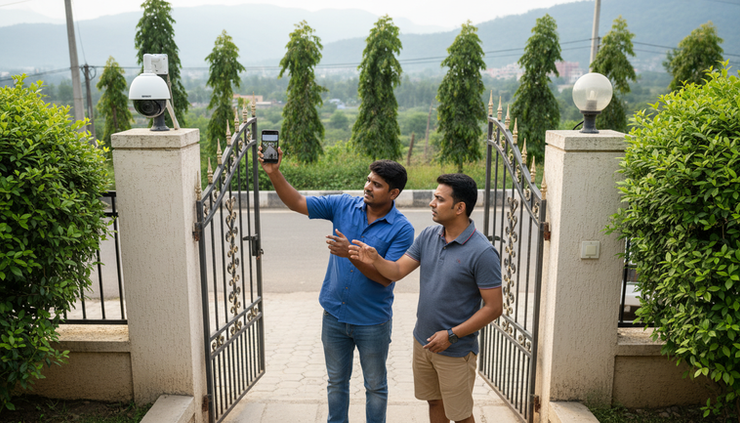
FAQ
How much does CCTV installation cost in Siliguri?
The cost depends on camera count, brand, resolution, hard disk size, cable length, and installation difficulty. A small home setup costs less than a warehouse or hotel system. Ask for an itemised quote instead of only a package price.
Which is better for Siliguri, wired CCTV or Wi-Fi CCTV?
Wired CCTV is usually more stable for shops, homes with multiple cameras, warehouses, and outdoor areas. Wi-Fi cameras work well for small spaces where wiring is difficult, but they depend on router strength and continuous power.
How many CCTV cameras are enough for a house?
Many homes start with cameras at the main gate, front door, parking area, and one or two side or common areas. The right number depends on blind spots, property size, and whether you need face capture or only general monitoring.
Should I buy CCTV online or from a local dealer?
Online buying can work if you know the exact models and have a skilled installer. A local dealer or distributor is often better when you need site planning, warranty help, quick replacement, and after-sales service.
Can CCTV work during a power cut?
CCTV needs power. If power cuts are common, connect the DVR or NVR, router, and cameras to a suitable UPS. The backup time depends on UPS capacity and total load.
Final buying checklist before you confirm installation
Before paying the advance, confirm these points in writing:
Camera model numbers and quantity
DVR or NVR channel capacity
Hard disk storage size and estimated recording days
Warranty period for cameras, recorder, and hard disk
Cable type and installation method
Mobile viewing setup
Password handover process
Service visit charges after installation
Replacement process for faulty equipment
A good CCTV system should give clear footage, reliable recording, safe remote access, and service support when something goes wrong. The lowest quote may look attractive, but poor installation can cost more through blind spots, failed recordings, and repeated repairs.
For a site survey, product selection, and CCTV installation support, visit Tech Infinity India.
The right installer will not push the same package for every property. They will study the site, explain the trade-offs, and build a system that answers your real security needs. That is the difference between simply buying cameras and building dependable surveillance.


Comments